Posts

Showing posts with the label Square Jam

#523 - Square Jam

Image
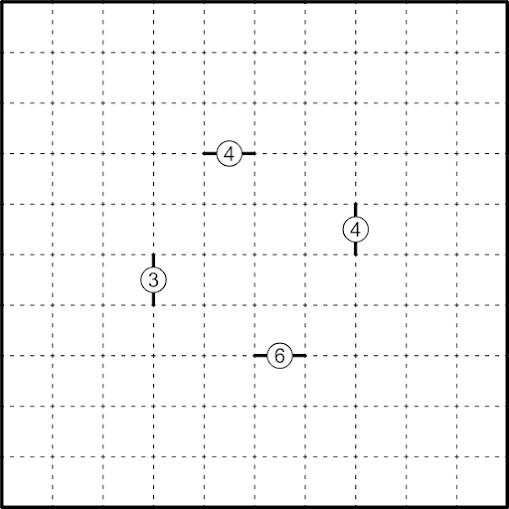
       Divide the grid into square regions of orthogonally connected cells. A number indicates the side length of the square it’s in. Region borders may not form any four-way intersections. Solve online

#514 - Square Jam

Image
       Divide the grid into square regions of orthogonally connected cells. A number indicates the side length of the square it’s in. Region borders may not form any four-way intersections. Solve online

#505 - Square Jam

Image
       Divide the grid into square regions of orthogonally connected cells. A number indicates the side length of the square it’s in. Region borders may not form any four-way intersections. Solve online

#499 - Square Jam

Image
    I find that the majority of Square Jam puzzles rely on 1s or on clues near the edges of the grid for the solving path to get started. This puzzle was a result of me exploring the idea of a puzzle which has none of those.        Divide the grid into square regions of orthogonally connected cells. A number indicates the side length of the square it’s in. Region borders may not form any four-way intersections. Solve online

#478 - Square Jam (Voxas)

Image
       Divide the grid into square regions of orthogonally connected cells. Region borders may not form any four-way intersections. Borders with white dots separate two squares with the same size. Borders with black dots separate two squares with different sizes. Solve online

#466 - Look-Air / Square Jam Hybrid

Image
       Divide the grid into square regions of orthogonally connected cells and s hade some cells so that each region is either fully shaded or fully unshaded.  Region borders may not form any four-way intersections.  Clues represent how many of the five cells forming a cross around the clue (including itself) are shaded. Two shaded squares may not be orthogonally adjacent. Two shaded squares of the same size may not have a vertical or horizontal line of unshaded cells between them, unobstructed. Solve online

#440 - Square Jam (Sum)

Image
       Divide the grid into square regions of orthogonally connected cells. Borders must separate two different squares. A number on a border indicates the sum of the side lengths of the squares it separates. Region borders may not form any four-way intersections. Solve online

#439 - 2x Square Jam

Image
    Here are two more puzzles of this new genre that I've combined into one post because the first is stupid and the second is small. Neither of the "1" clues are necessary in the first puzzle, but I've included them for aesthetic purposes.        Divide the grid into square regions of orthogonally connected cells. A number indicates the side length of the square it’s in. Region borders may not form any four-way intersections. Solve online Solve online

#438 - Square Jam

Image
       Divide the grid into square regions of orthogonally connected cells. A number indicates the side length of the square it’s in. Region borders may not form any four-way intersections. Solve online

#437 - Square Jam

Image
     I've created another puzzle genre that I'm excited to share. Here it is: Square Jam!      Divide the grid into square regions of orthogonally connected cells. A number indicates the side length of the square it’s in. Region borders may not form any four-way intersections. Solve online

#300 - My Original Genres

Image
     For my 300th post, I've put together a collection of example puzzles for all of my original puzzle genres. As I create more in the future, this post will get updated. I hope you enjoy!     1.  Ovotovata  (oh-VOH-toh-VAH-tuh)      Draw a non-intersecting loop through the centers of some cells which visits each shaded region at least once. When the loop exits a clued region in any direction, it must travel in a straight line for exactly the indicated number of cells (turning on the Nth cell, where N is the value of the clue). Solve online                                                    Solve online View solutions     2.  Aqre  (AY-kurr)      Shade some cells so that all shaded cells form one orthogonally connected area. Regions with numbers must contain the indicated am...